
Aerodynamic Solvers: 2D Panel Method & Lifting-Line Methods
Project Overview
This project showcases the development of two foundational aerodynamics solvers in Python, built from fundamental principles. The first is a 2D potential flow solver (a panel method) used to analyze airfoil sections. The second is a 3D lifting-line theory (LLT) solver for finite wings.
Together, these tools demonstrate a comprehensive approach to modeling and predicting aerodynamic performance, from 2D pressure distributions and lift curves to 3D spanwise lift distributions and wing performance.
2D Airfoil Panel Method
The first part of this project involved creating a 2D panel method solver. The objective was to create a robust tool capable of modeling inviscid, incompressible flow over arbitrary 2D airfoils to predict their aerodynamic properties.
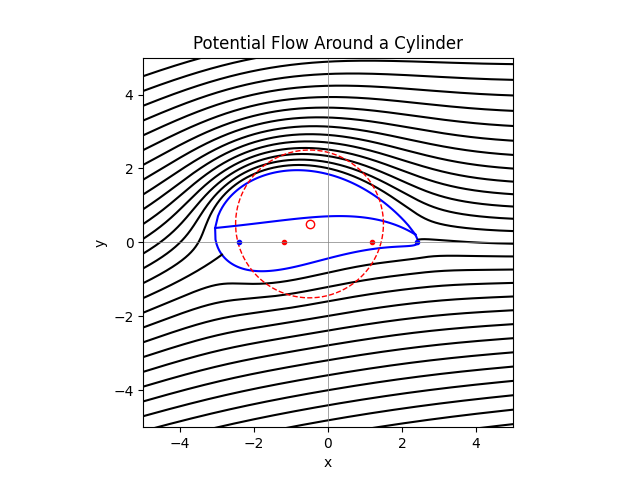
This solver’s capabilities are demonstrated in the included PDF report, which covers a variety of examples showcasing the functionality of the solver.
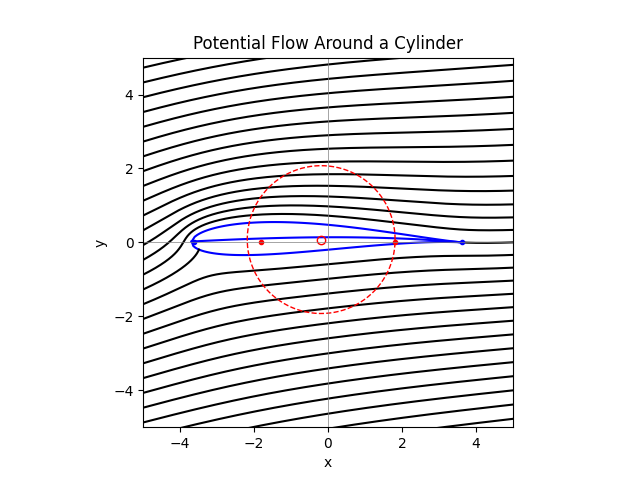
Functionality
- Streamline Visualization: Plots potential flow streamlines around various airfoil geometries (like the NACA 2412, 2421, and 0015) at different angles of attack to visualize flow behavior.
- Lift Curve Validation: Generates lift-curve slopes ($C_L \text{ vs. } \alpha$) and validates them against experimental data, thin airfoil theory, and other established solvers like XFOIL.
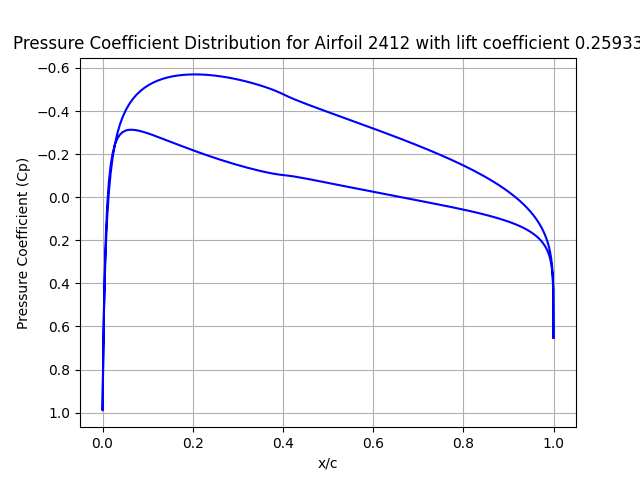
- Pressure Distribution: Calculates and plots the pressure coefficient ($C_p$) distribution over an airfoil’s surface. This is essential for identifying regions of high and low pressure and for calculating the overall lift.
Lifting-Line Theory
The second part of this project, expands the 2D analysis to a 3D finite wing using Prandtl’s Lifting-Line Theory (LLT). This model is crucial for understanding the effects of finite span, including induced drag and spanwise lift distribution.
Key Functionality:
- Fourier Series Solution: Solves for the wing’s circulation distribution by representing it as a Fourier series. This allows for the calculation of aerodynamic coefficients from a set of Fourier coefficients ($a, b, c, d$).
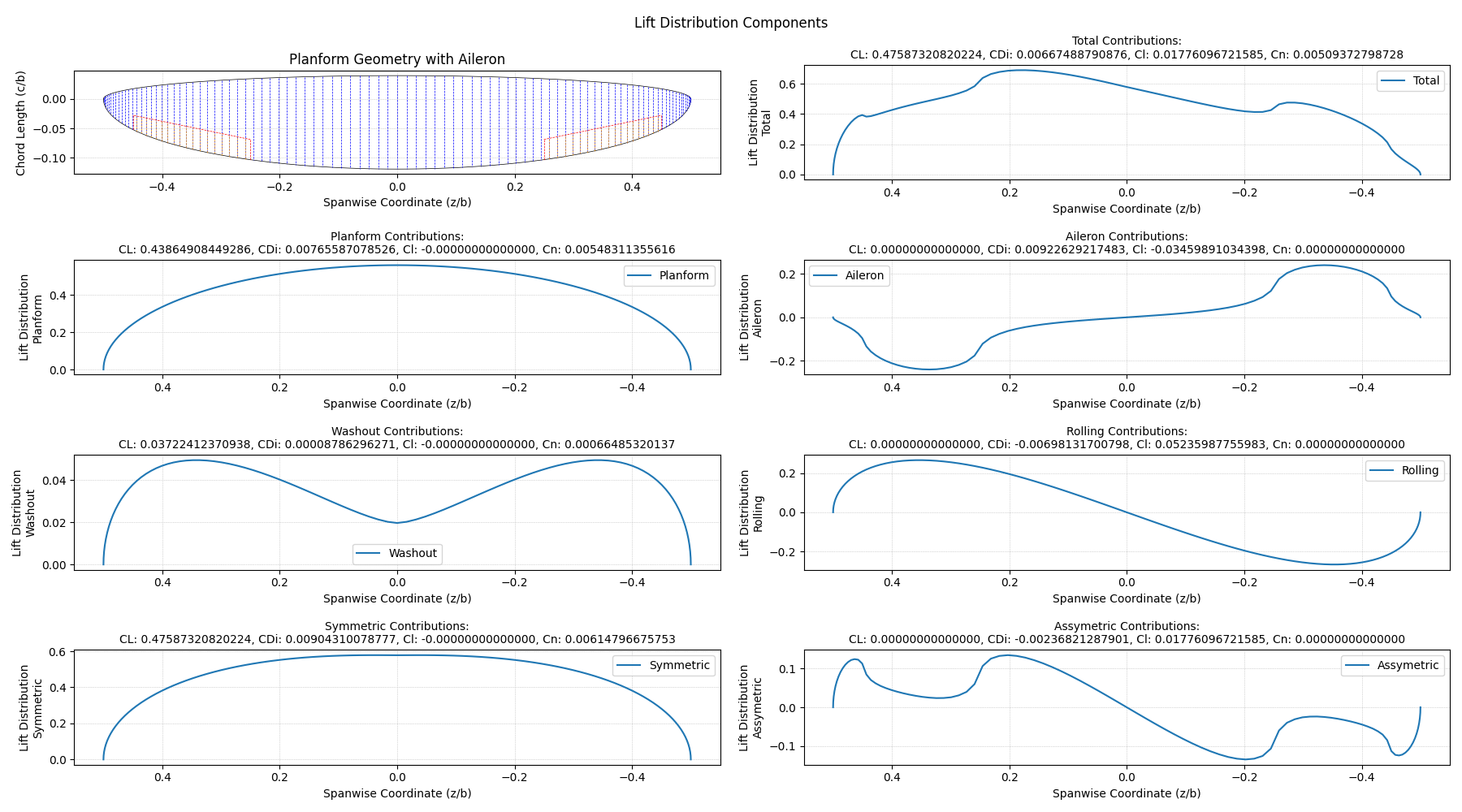
- Spanwise Lift Distribution: Plots the distribution of lift across the wingspan ($z/b$) and, most importantly, decomposes the total lift into its fundamental components.
- Component Analysis: The solver isolates the aerodynamic contributions from:
- Symmetric Loading: Wing planform geometry (angle of attack) and wing twist (washout).
- Asymmetric Loading: Control surface deflection (ailerons) and vehicle motion (roll rate).
- Aerodynamic Coefficients: Integrates the spanwise distributions to find the total wing’s aerodynamic coefficients, including the lift coefficient ($C_L$), induced drag coefficient ($C_{Di}$), rolling moment coefficient ($C_l$), and yawing moment coefficient ($C_n$).
- Planform Visualization: Includes a plotting function to visualize the wing’s planform geometry, taper, and aileron locations.